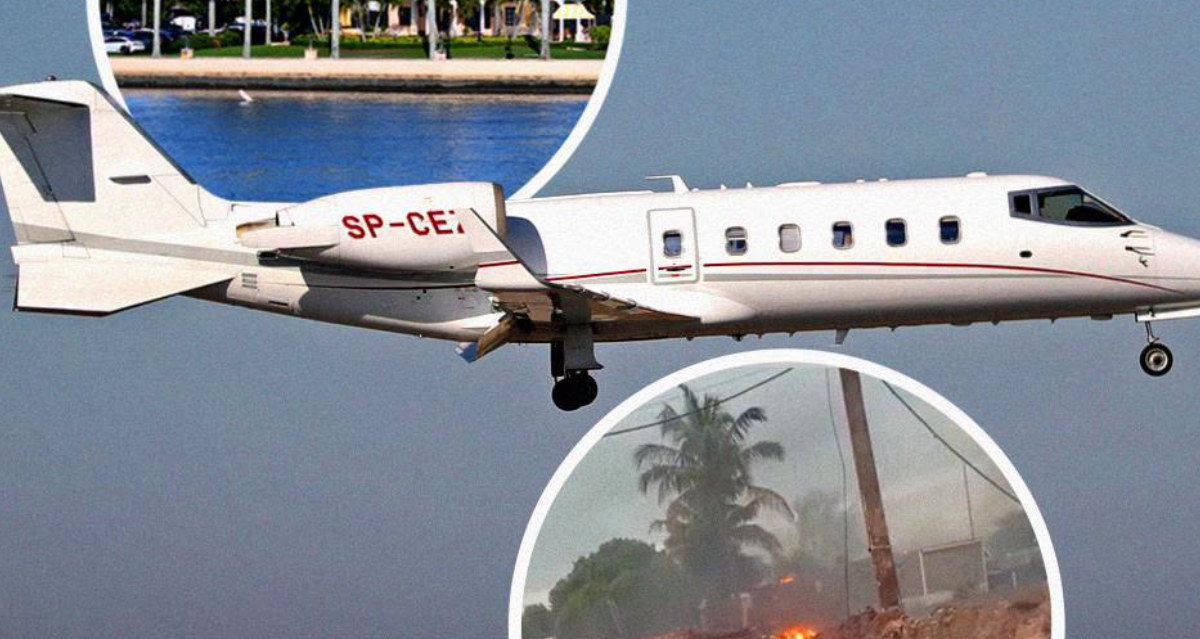
A Learjet 60 crashed into a Florida neighborhood, killing all nine people aboard. Dashcam footage captured the aircraft plunging toward the ground, while chilling cockpit recordings reveal the crew’s desperate final attempts to regain control.
An ordinary Sunday afternoon in a Florida neighborhood turned into a scene of devastation when a business jet suddenly came crashing down onto a busy road.
The aircraft left behind a massive crater, scattered debris, and a fireball that sent thick black smoke billowing over nearby homes, but what happened inside the cockpit in the moments leading up to the disaster is even more disturbing.
The Learjet 60 was carrying nine people from Austin, Texas, to the Bahamas when it crashed in Palm Beach County, Florida, on November 1, 2026. The aircraft went down around 12:50 p.m. EST near Cresthaven, approximately nine miles from President Donald Trump’s Mar-a-Lago resort.
Trump had also been in the area earlier that morning, having departed from a nearby airport aboard Air Force One just over an hour before the crash.
All nine people aboard were killed, according to U.S. Transportation Secretary Sean Duffy. Authorities said no one on the ground was injured. According to the Federal Aviation Administration (FAA), the aircraft had departed from Austin-Bergstrom International Airport and was headed to North Eleuthera Airport in the Bahamas.
The crash occurred on Military Trail, a six-lane thoroughfare lined with businesses and homes. Images from the scene showed a large crater in the middle of the road, with burning debris and wreckage scattered across the surrounding area.
But the most frightening details would emerge from recordings of the aircraft’s final communications with air traffic control.
The Pilots Initially Reported Turbulence Before Something Went Terribly Wrong
In the minutes before the crash, the Learjet crew was dealing with difficult weather conditions, including turbulence, icing, and precipitation. According to recordings of the final cockpit communications, archived by LiveATC.Net, the pilots were communicating with air traffic control about the conditions surrounding their aircraft.
At one point, air traffic control asked about the outside air temperature. The pilot responded, “Minus 47 degrees Celsius. We’re managing the ice, but it is moderate turbulence.” The exchange initially appeared to be a routine discussion about the weather. However, the situation soon became more alarming as the aircraft encountered precipitation.
“Now we’re picking up precipitation. We need to climb,” the pilot told air traffic control. The controller responded, “Roger. Climb and maintain.”
What followed was a frightening change in the aircraft’s flight path.
‘Mayday, Mayday’: The Learjet Began Plunging Thousands of Feet per Minute
According to the recordings, the pilot soon reported that the aircraft was losing altitude at an alarming rate. “We’re descending 8,000. Mayday, mayday. We’re descending 10,000 feet per minute. Declaring emergency 722 Bravo Delta. We are in an oversea condition, descending 20,000 feet per minute.”
The crew had declared an emergency, but the aircraft’s descent was becoming increasingly difficult to manage. Air traffic control attempted to maintain communication with the pilots, asking what assistance they needed. “Let me know what you need,” the controller said.
The response from the cockpit was chilling. “We’re gonna crash into the ground,” the pilot said. The controller continued trying to communicate with the aircraft, responding, “November two Bravo Delta. I’m here with you. Talk to me.” The pilot then reported, “We are descending 22,000 feet, and we are banking 60 degrees.”
Another portion of the recording captured what Fox 35 described as an inaudible scream, followed by the words, “Look outside.” Air traffic control made another attempt to reach the crew, asking, “November two Bravo Delta. How do you hear?”
The BBC also reported that the crew’s final recorded remark came approximately 35 seconds after the initial mayday announcement. “We’re out of time,” the voice from the cockpit said.
By then, the aircraft was descending at an extraordinary speed, with the crew apparently unable to recover control.
Dashcam Footage Captures the Moment the Jet Plunged Into the Neighborhood
The terrifying final moments were also captured in footage circulating on social media. A video showing the apparent moment of the crash appears to have been recorded by a vehicle’s dashboard camera as cars traveled along an ordinary suburban road.
In the footage, the aircraft suddenly comes into view, plunging toward the ground at an almost vertical angle before disappearing into a massive explosion.
A huge fireball erupts at the impact site, followed by an enormous cloud of dark smoke that rises above the surrounding homes and trees. The scene is particularly unsettling because the aircraft appears to fall directly into an area where people would ordinarily be driving or going about their daily activities.
Additional footage from the neighborhood shows the thick smoke spreading across the sky as vehicles stop along the roadside. Several people can also be seen gathering nearby and looking toward the crash site.
The footage has not been independently verified, but it provides a disturbing glimpse of the disaster as it unfolded. Florida Governor Ron DeSantis described the impact as particularly shocking when he addressed reporters after the crash.
“When you see that video, it’s a jarring thing,” DeSantis said. “It’s like a missile coming down, and a massive explosion, debris going everywhere.” The governor also described the incident as a catastrophic crash that left a large crater along the roadside.
Around 600 Residents Evacuated as the Crash Damaged the Neighborhood
While all nine people aboard the aircraft died, the impact also caused significant disruption for people living near the crash site. Palm Beach County Fire Rescue declared a mass casualty incident as emergency personnel rushed to the area. Authorities said the crash damaged local infrastructure, including water lines, while debris was scattered across Military Trail.
The damage also affected access to a nearby mobile home park, leaving approximately 600 residents in need of temporary shelter. Joel Flores, a Palm Beach County commissioner for District 3 who was the first county official at the scene, said residents were being directed to two shelters while investigators examined the crash site.
The scale of the impact was also evident in accounts from people who experienced the explosion nearby. “I heard and felt the boom,” Andrew Mannino told CNN. “The power immediately went out and is still out.” Mannino said he also smelled smoke and “saw a large black cloud immerse in the air.”
The authorities warned that the damage to the road and surrounding infrastructure would take time to repair. Officials estimated that Military Trail could remain closed for at least 30 days.
What Could Have Sent the Learjet Plunging Toward the Ground?
While the pilots’ final communications revealed a terrifying struggle to keep the aircraft under control, investigators are still trying to establish what triggered the emergency.
Weather conditions could offer some important clues. Thunderstorms were reported across the area when the Learjet crashed, and according to CNN’s report on the investigation, the aircraft had passed through a stronger storm cell just minutes before it began its rapid descent.
However, officials have not established whether the storm contributed to the crash or whether another problem caused the aircraft to lose control.
The aircraft’s extraordinary descent has also caught the attention of aviation experts. Mary Schiavo, a CNN aviation analyst and former inspector general for the Transportation Department, said the dashcam footage could prove valuable in helping investigators reconstruct the final moments.
“That is not a controlled descent,” Schiavo told CNN. “It’s clear, whatever happened, they had lost control of the plane.”
Schiavo also explained that the force of such a steep descent could have caused parts of the aircraft to break away. The subsequent explosion may have destroyed the flight data recorder, potentially making it more difficult for investigators to reconstruct exactly what happened.
Another detail investigators will likely examine closely is the pilots’ repeated references to icing before the emergency. Ice accumulating on an aircraft’s wings and other surfaces can interfere with airflow, making it difficult to maintain stable flight.
The danger is serious enough that the National Transportation Safety Board (NTSB) issued a safety alert in January 2024 specifically addressing the risks of in-flight icing. The agency warned that ice can “make managing the airplane’s flightpath and airspeed more difficult and can prevent the airplane from maintaining level flight.”
Still, the pilots’ reports of managing ice do not establish that icing caused Sunday’s disaster. Investigators will need to determine whether it affected the aircraft’s performance and whether other factors, including the storm conditions, played a role.
Transportation Secretary Sean Duffy described the crash as a “horrific tragedy” and said the Federal Aviation Administration was sending a team to assist the NTSB with its investigation. “Please join me in praying for the families and loved ones of those we lost,” Duffy added.
Authorities have yet to identify the nine people killed aboard the aircraft or confirm how many were passengers and how many were crew members. Investigators are expected to examine the wreckage, available flight data, cockpit recordings, weather conditions, and maintenance records as they work to establish what happened.
This Was Not the First Fatal Learjet 60 Accident
The Florida disaster also brings renewed attention to the safety history of the Learjet 60, although a previous accident involving the same aircraft model occurred under very different circumstances. On September 19, 2008, another Learjet 60 crashed while attempting to take off from Columbia Metropolitan Airport in South Carolina.
According to an investigation report on the 2008 accident, the NTSB determined that severely underinflated tires and the crew’s decision to reject the takeoff after reaching V1 were the probable causes.
All four tires failed during the takeoff roll, and fragments damaged a component of the aircraft’s thrust-reverser system. The resulting malfunction caused the engines to provide forward thrust when the captain was attempting to stop the aircraft.
The accident killed the captain, first officer, and two passengers. Two other passengers survived with serious injuries. The investigation identified several contributing factors, including inadequate maintenance, deficiencies in the aircraft’s thrust-reverser design, and shortcomings in crew resource management.
The circumstances of that accident are different from those surrounding Sunday’s crash, and investigators have not established any connection between the two incidents. The Learjet 60, which was introduced in the early 1990s, is a twin-engine business jet designed to carry a flight crew of two and, depending on its seating configuration, between six and nine passengers.
Its first flight took place in October 1990, and it received certification in January 1993, according to aircraft information published by Forecast International.
Another Recent Plane Crash Raises Questions About the Dangers of Icing
The Florida disaster comes just weeks after another fatal plane crash in Wisconsin in which the pilot also reported icing while flying through a thunderstorm. On October 13, 2026, six people, including a child, died when a six-seat Piper PA-46 Malibu crashed in a wooded area near Mirror Lake State Park, close to Wisconsin Dells.
The aircraft was traveling from Kenosha to Menomonie when it went down shortly before 10 p.m. as rain fell and a thunderstorm moved through the Town of Dellona, according to the Sauk County Sheriff’s Department.
Before the crash, the pilot had alerted air traffic control that ice was building up on the aircraft’s wings while it was flying at 24,000 feet (7,315 meters). The pilot requested permission to descend, and air traffic control approved the maneuver.
However, the aircraft subsequently entered a descending right turn that became increasingly steep until communication and flight tracking were lost, the National Transportation Safety Board (NTSB) said.
FlightRadar24 data showed the plane descending at up to 4,000 feet per minute, while its airspeed nearly doubled to 340 mph. “It has all the earmarks of an icing-related loss of control,” aviation safety expert Jeff Guzzetti, a former NTSB and Federal Aviation Administration crash investigator, said.
The Wisconsin crash also brought attention to earlier concerns about icing involving the Piper Malibu and Mirage aircraft models. The NTSB had previously conducted a special safety review of seven icing-related crashes involving the two models between 1989 and 1991.
Several of those incidents involved relatively inexperienced pilots who were unfamiliar with handling sophisticated aircraft in icing conditions. Following its review, the NTSB recommended changes to pilot training, aircraft checklists and manuals, as well as improvements to indicators for systems that heat pitot tubes.
Those heating systems help prevent ice from interfering with the instruments used to provide pilots with accurate airspeed information. In the Wisconsin crash, authorities confirmed that all six people aboard died, while nobody on the ground was injured and no structures were damaged. The NTSB is leading the investigation into that incident.
Although the Wisconsin and Florida crashes involved different aircraft, the pilots’ reports of icing make the incidents a sobering reminder of the dangers severe weather can pose to aircraft. Investigators have yet to establish whether icing contributed to either plane crash.